Posts

Guerilla Gardening and the Three Little Soils.

In our first unit of FOOD class, we have discussed ecosystems, mathematical inequalities, and soil quality for gardening. We also had the opportunity to visit the Plant Chicago, which is an organic gardening space that uses aquaponics to provide nutrients to the soil. There, we tested soil quality, much like we did in class. We learned about the three types of nitrogen found in soil: ammonia, nitrites, and nitrates.  We also returned to in-person school for two days a week. It's fun to be in the classroom with everyone again. (We miss you RL and LA!)  Our Action Project is building on a theme that Rock (our leader at the Plant Chicago) talked to us about: anyone can be a farmer. And another video showing a "guerilla gardener" in Los Angeles made the same point: anyone, anywhere, can farm. So, for our action project, we are going to grow three plants. The difference: the soil quality between the three gardening containers.  Now, our three plants will be in three separate c...
TALKIN' ABOUT FOSSIL FUELS!

 So this winter has been cold!   You know how to make it warmer?  BURN STUFF! For our Fuel class we're done just that by learning about combustion, an exothermic chemical reaction, and demonstrating lots of fires.  Like, camping fuel, matches, even a big campfire.  We've talked about how different countries use different fuels, and used algebra to predict future trends in these fuels.  We even met with Christa Markgarff, an expert with Nicor Gas who has great knowledge of energy trends in the US. In the following slideshow, you can see lots of information and details on all of these things.  There was a lot to learn -- but, even more interesting, there's a lot more questions I hope to answer moving forward!

My humble garden.

Image
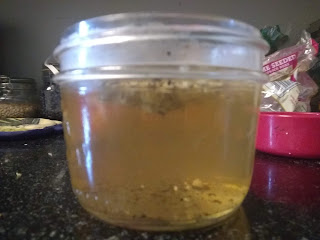
Welcome to virtual school!  Our food class, like all other classes at GCE, is online due to the stay-at-home guidelines across Illinois.  Digitally, though, we have been able to connect on Zoom for our daily classes, where we have learned about healthy soil and nutrients.  We read a book titled "One Straw Revolution" and we watched a movie called Dirt!.  Although it prompted some thinking about what makes for a healthy gardening ecosystem. With that in mind, it was time to create our own garden!  We received some soil and seeds -- our GCE 'Lab Kits" arrived in the mail -- and with that I could plant a small garden container.  First, though, I had to test the soil for primary macrnutrients using soil capsules (also received in the GCE lab kit).  I created a soil solution and dropped my capsule in.  Notice the orange color of the water after the soil test capsule was dissolved in the water -- this indicates a high level of potassium in the soil....

QUE VA A PASAR CON EL CLIMA??

In the water class, for our third unit, we had a very rushed schedule.  We actually had an interesting Field Experience to the Chicago River to meet a scientist who sampled water from the river to examine how the floating gardens in the river filtered metals out of the river.  Unfortunately, this project fit very well with our unit #2 on water filtration, but because of the schedule (including a nasty snow storm on Halloween that delayed us!) we postponed this FE until unit #3. A second FE that was very interesting was a trip to the Field Museum to view an exhibit on water.  It was a very cold and windy day, and it's a long walk to the museum from the train.  But, once we arrived, we got to visit a photography exhibit of 'green infrastructure' including a picture from the Jardine plant that we had visited during Unit #2.  After viewing the exhibit, we went to a classroom in the top floor of the Field Museum and simulated global warming with students acting lik...

THE WORLD'S CRAZIEST KITE... and COMBINATIONS.

Image
Pascal's Triangle is a really neat pattern of numbers.  The numbers in Pascal's Triangle represent mathematical combinations, given by the formula: nCr =  n! / (r!)(n-r!) For example, if I have 10 people in a room, and I need to choose 3 people to join my team on a GCE scavenger hunt, there are 10C3 = 10! / 3! x 7! = 120 ways to choose 3 people. Look at Pascal's Triangle: The numbers in this triangle relate to the value in the formula above. Now, here's a very interesting kite picture.  From more than 100 years ago! What is that crazy thing??  It's a kite created by Alexander Graham Bell (do you know who he is?  You probably own something he invented!!) based on a geometric shape called a Sierpenski Triangle.  I think it's incredibly cool.  I like how the person is holding the kite with what looks like a fishing pole in the bottom of the picture. And you know what, Sierpenski Triangles 'live' inside of the Pascal Triangle, too.  Wha...